

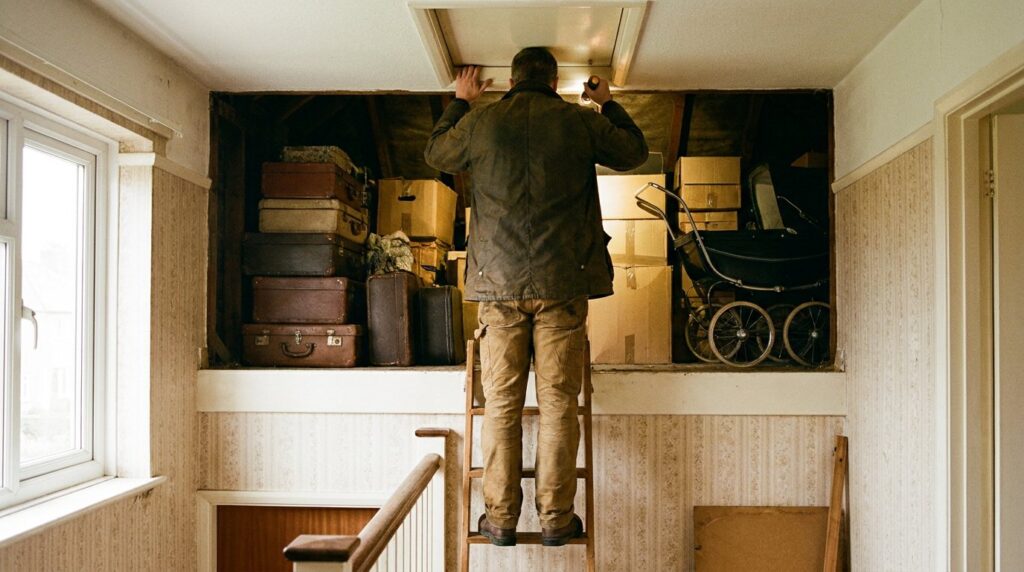
Topping up the loft insulation is one of the first improvements many people plan after moving into an older home. It sounds simple until someone climbs through the hatch and finds the space packed with the last owner’s forgotten suitcases, or with the boxes that came off the removal van and went straight upstairs because nobody could face unpacking them.
Why the space has to be empty first
Insulation works by trapping still air, so it needs to lie evenly between and across the joists. Anything left standing on it squashes it and reduces how well it performs. Installers also need to see what they are working around: cables, pipes, water tanks, roof timbers and any signs of damp. A loft full of belongings hides all of that.
Some installers will shift a few items along the loft as they go, but many expect a clear space before they arrive. Ask what yours requires when you book, and find out whether they want the whole floor empty or only the areas they are treating. It is far better to know that a fortnight ahead than on the morning they turn up.
Settle the question on moving day
If you have not moved yet, you have a rare chance to avoid the problem altogether. Mark any box destined for the loft and ask yourself whether it really needs to go up there at all. Keep seasonal decorations and the odd suitcase in a spare cupboard for the first few weeks, then lift them into the loft after the work is finished.
When you view a property or do a final walk-round, ask the sellers whether the loft will be emptied. Things left behind in roof spaces are easy to overlook, and it helps to raise the point through your conveyancer before completion rather than discovering it afterwards.
Bringing everything down without damage
Lofts are awkward places to work. Unboarded areas leave you balancing on joists, and a foot placed between them can come straight through the ceiling below. Light is often poor, the hatch is usually small, and heavy boxes are hard to control on a ladder. A few habits make it safer:
- Never do the job alone; have someone at the foot of the ladder to receive each item.
- Lay temporary boards across the joists rather than stepping from one to the next.
- Take a proper work light, as the bulb up there will not reach the eaves.
- Cover the landing carpet and keep the route to the stairs clear.
- Open every box before it goes, because paperwork and photographs often end up in the unlikeliest places.
Be cautious around anything you cannot identify. Older homes can contain loose-fill insulation or boards that may include asbestos, and these should be left undisturbed until they have been checked. The Health and Safety Executive publishes guidance on what to do.
When to hand the job over
A loft containing a few boxes is a reasonable Saturday task. One holding decades of accumulated belongings, heavy trunks or lengths of stored timber is a different matter, especially if the hatch is narrow and part of the floor is unboarded. Many people decide the risk to themselves and their ceilings is not worth taking.
Clearance firms handle this kind of work routinely. In Staffordshire, for example, 24/7 House Clearance offers loft clearance in Lichfield and the surrounding towns, lowering items through standard and small hatches, protecting landings and ceilings below, and setting aside any family documents found along the way. It can also take away old insulation and stored timber, then leave the roof space swept clean.
Lining up the order of work
Once the loft is empty, get any repairs or electrical checks done before the new insulation is laid, since reaching them afterwards means disturbing it. If you want storage up there in future, tell the installer now: boards laid straight on top of insulation compress it, so raised decking may be the better option.
A little sequencing at this stage saves a lot of climbing up and down later. Clear first, check what the empty space reveals, then insulate, and only return what you truly need to keep.